

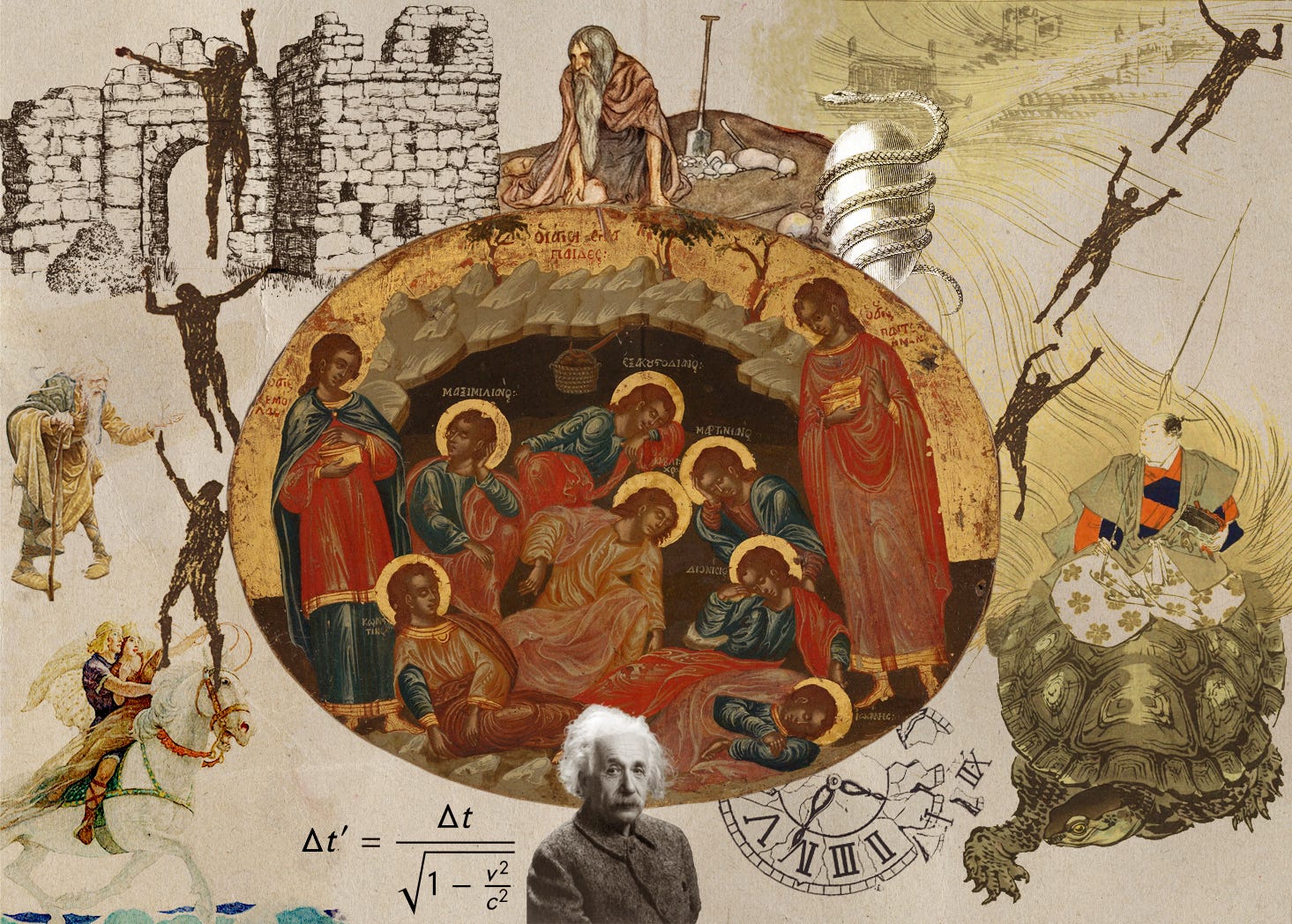
Nowadays time travel is a common trope that fixes plot holes in marvel movies. But long before sci-fi started normalizing wormholes, humanity was always obsessed with the idea of missing time. In almost every major mythology across the globe, the supernatural was dangerous because time worked differently. Stepping across an invisible boundary into a fairy mound or sacred cave would detach you from one of humanity’s core connections, time. Long before anyone put a name to the mechanics, they were already terrified of the idea that time itself is something that can slip away while you’re distracted.
Take the Irish legend of Oisín, a legendary warrior and poet. The story begins on the shore of Lough Leane, where Oisín and his father were hunting. A majestic woman named Niamh of the Golden Hair rode up on a massive white horse that could walk across the ocean waves without sinking. This was because Niamh was the daughter of the sea god Manannán Mac Lir, and she had come to invite him to her home (the Land of the Youth). It was a realm hidden away from the mortals where no one aged or suffered human illness. Intrigued by the promise of eternal life, Oisín climbed onto the back of the enchanted steed. The two galloped across the Atlantic, as Oisín watched the coast of Ireland fade into the fog, he slowly vanished into the other world (Tír na nÓg).
Oisín thought he only spent three years in Tír na nÓg feasting and hunting, but despite the never-ending pleasure, he felt deeply homesick. Niamh let him borrow her white horse to return for a visit to the isle, with one strict warning: no matter what happens to never dismount the horse and touch Irish soil. “I tell thee, Oisín, it is a true story, if thou alightest off the horse, thou wilt be a withered old man, blind and without strength, without power, without speed.” When he arrived through the fog of the ocean, the Ireland he remembered was gone. The majestic stone forts he grew up with had become ruins, overgrown with moss. His father’s band of warriors had been long dead, buried into the earth under the giant horse’s hooves. As he rode through a valley, he spotted a group of men struggling to lift a massive boulder off of the road. He approached and offered help, leaning off his saddle to help lift the stone. As he did one of the leather saddle straps snapped, sending Oisín tumbling to the ground. As his boots touched the grass, three hundred years of deferred aging hit his body in an instant. His young frame withered into a blind dying man, before he could even push himself up and address the damage. The horse reared screaming, and galloped back into the sea, disappearing into the horizon. Oisín tragically learned his lesson because he didn’t follow his promise, and the clock finally caught up to him.

Across the world in 8th-century Japan, storytellers were dealing with these same themes. Moving from the Irish hills down to one the most terrifying places on earth, the bottom of the ocean. The story of Urashima Tarō begins on Honjohama beach in ancient Japan, with a fisherman who thought he was just doing a good deed. Tarō was walking down the coast one morning, as he spotted a group of kids tormenting a small turtle on the sand. He immediately approaches them, offers to buy the turtle off of them, and releases it back into the water to swim away. A few days later, while out in his boat fishing, a monstrous sea turtle surfaces above the water right next to his boat. The turtle tells him she’s a messenger from Ryugu-Jo (the Dragon Palace) from the bottom of the ocean, and offers him a ride down as a thanks for saving the little turtle on the sand. Tarō climbs onto her shell, dives into the sea, and arrives at an underwater palace built of coral and jade. The mysterious underwater utopia was complete with its own seasons. Cherry blossoms were in the east, Autumn leaves in the south, and winter snow in the north, representing artificial symbols of time. Tarō is welcomed in by Princess Otohime, treated to banquets, and entertained by dancing fish (sounds like Little Mermaid on acid). Three lavish days later, Tarō becomes nostalgic for home, thinking about his elderly mother waiting for him above back on the Japanese Coast.
Tarō asked the underwater royalty to let him return to the surface world. The princess tries to stop him, but once she realizes his mind is made up she gives him a gift. She handed him a small ornate wooden box tied with a purple silk cord (a Tamatebako), along with one strict rule: “Take it, but whatever you do, do not open it”. Tarō agrees, rides the giant turtle back up to the surface and steps onto his home beach. As his feet touched the sand he realizes something is wrong. The trees that lined the beach when he left were gone and the shoreline had moved. The wooden huts he grew up around had been replaced by new buildings he had never seen before, full of strangers wearing strange clothes. Understandably freaked out, he ran to the plot of land where his family’s house stood, arriving to nothing but an overgrown field. Panicked by the sight, he found an old villager and asked if he knew where the fisherman Urashima Tarō lives. The old man looked at him like he’s crazy, telling Tarō that he was referencing an “old legend from three hundred years ago”. A local legend of a man who rowed out into sea and never came home, whose mother died grieving him centuries ago.
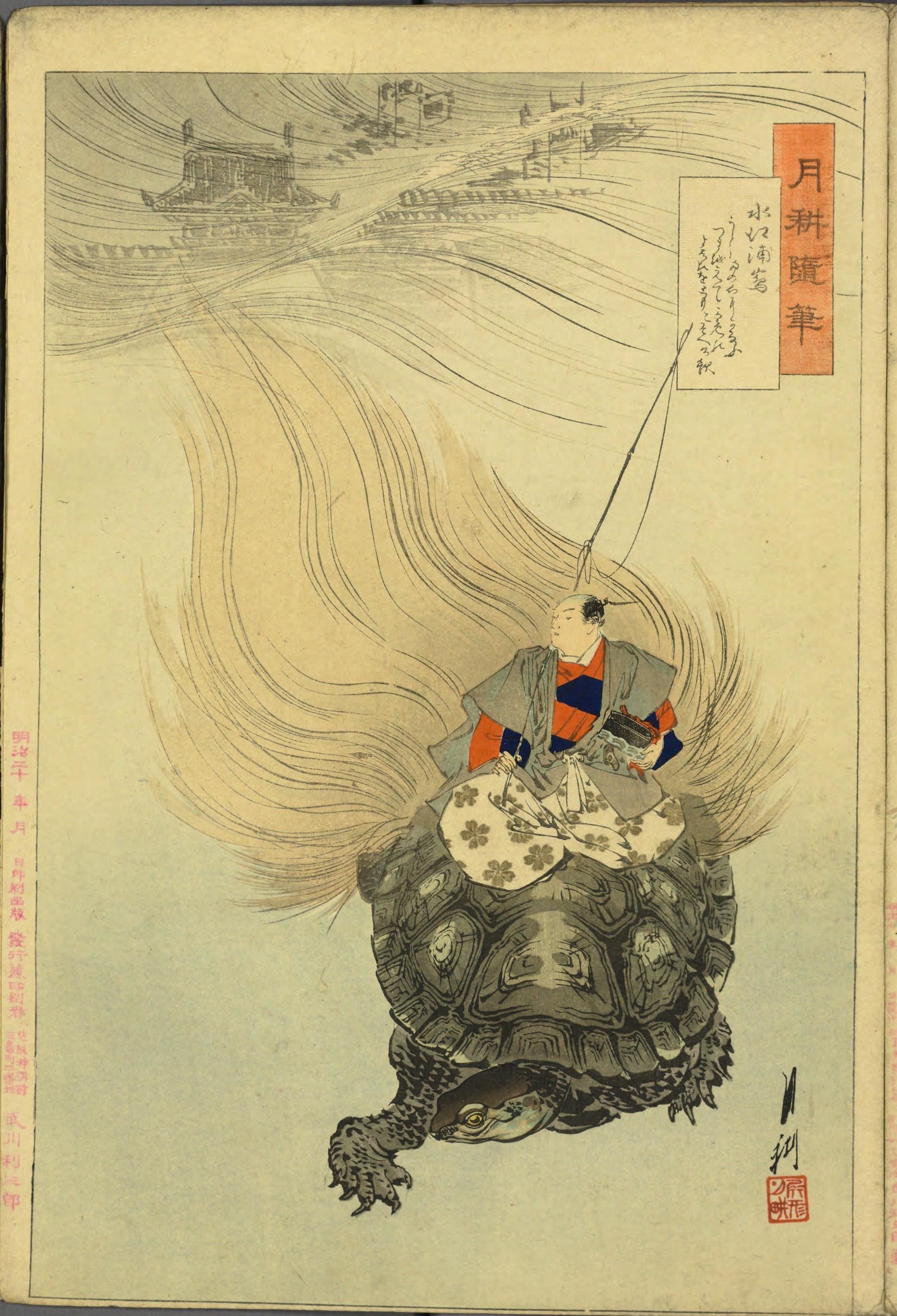
Standing in an unknown world, totally erased from his own history, Tarō went into full hysteria. Desperate for any connection to the ‘real world’, he forgets the princesses’ warning, unties the purple cord, and rips the lid off. As the lid opens, a thin wispy curl of white smoke drifts up into his face. He looks inside and finds nothing, empty like the memory of his existence.
“When the white cloud drifted out from the box and spread across his skin, his black hair turned as white as snow, his breath failed, his skin wrinkled, and he fell upon the shore.”
The smoke is the three hundred years he skipped. The moment it touched his hair turned to white. His teeth fell out, his back bent crooked, and his hands shriveled aggressively into leather. In the span of a single human breath, the physical reality caught up with him, and he collapsed onto the sand as an old man, dying on the empty beach.
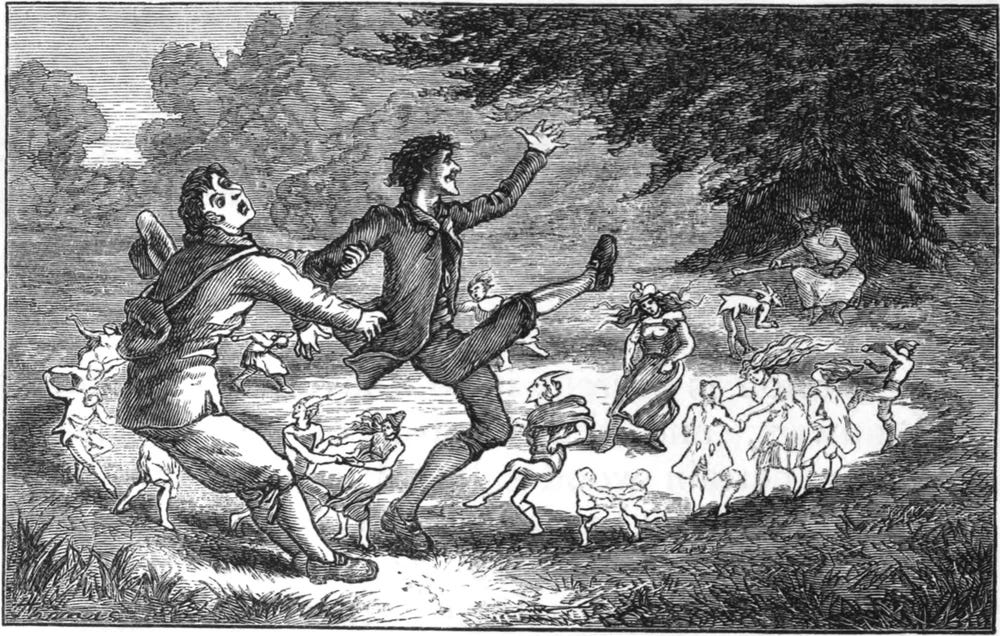
Stepping out of the timeline didn’t require a trip across (or under) the ocean. In medieval Wales, the boundary was right on the path home from work. Take the story of two farm servants, Rhys and Llewellyn, walking home at twilight. Rhys suddenly stopped, claiming he heard sweet fairy music drifting through the air, a tune he’d danced to a hundred times before. Llewellyn couldn’t hear a thing, but Rhys ran off into the dark, telling his friend to go on ahead without him. When Rhys didn’t return, for months after, the town accused Llewellyn of murder and threw him in prison. A full year later, a local farmer who knew the ways of the ‘Good People’ (which I did a deep dive on in an earlier transmission), convinced the town to take Llewellyn back to the spot where Rhys vanished. Standing at the edge of a mossy fairy ring, Llewellyn told them to place their feet on top of his. Instantly, the whole party could hear the harps and see dozens of fairies dancing in a circle. Right in the middle of the scene was Rhys, whirling around like a madman. Llewellyn grabbed Rhys by his coat and yanked him out of the ring. Rhys stumbled, looked around, and asked where the horses were, convinced that he’d only been dancing for five minutes. He had no idea a full year had passed, or that his friend had nearly been hanged for his murder while he was partying with the fae.
The mechanism of missing time wasn’t always portrayed as a tragic trap. Centuries earlier, in 5th-century Christian and Islamic lore, that same temporal freeze was repurposed into a story of divine protection. The legend of the Seven Sleepers began around 250 CE during the reign of the Roman Emperor Decius, who was on a campaign of executing Christians across the empire. In Ephesus, seven young men refused to renounce their faith. Before facing execution, the boys escaped into the mountains outside the city, and hid inside a deep limestone cave. When Decius found out where they went, he ordered his soldiers to seal the mouth of the cave with massive boulders, entombing them inside to die. Trapped in the pitch dark, they fell to their knees and prayed and suddenly fell into a deep sleep. When they woke up, they felt rested and their stomachs grumbled with hunger. Starving they dug out a few stones around the entrance and one of the boys, Malchus, wiggled his way through a small opening. He told the others he would sneak into town and bring back bread, but Malchus was not returning to the town they had been banished from.
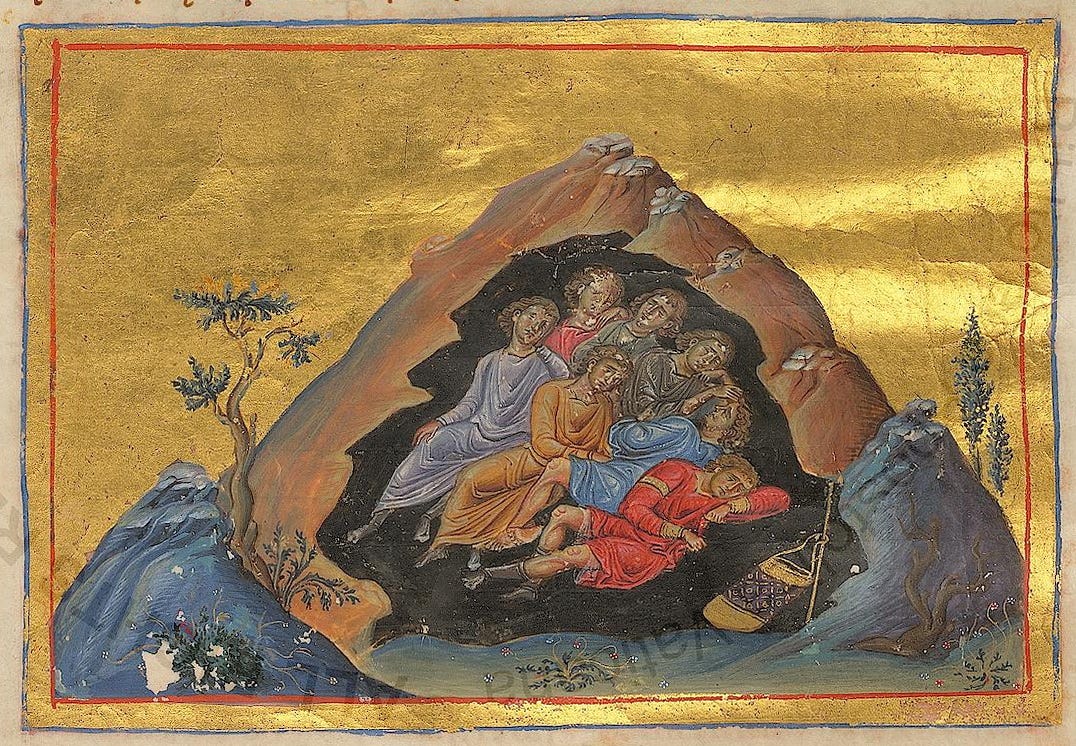
Malchus walked down the mountain expecting to have to hide from the Roman guards on patrol. Instead, the city walls were different. He saw a massive Christian cross sitting above the main gate, and in the market people were talking about Christ in the open. Paranoid that he was walking into a trap, Malchus decided to pay for the bread, pulling out a silver coin he had stashed before being banished. The baker stopped and stared at the coin confused. The silver bore the face of Emperor Decius, a man that had been dead for over two hundred years. The Roman Empire had fallen, Christianity was the state religion, and the city and life Malchus had once known, had been buried under two centuries of history while he slept in a cave. Realizing he was now safe, he approached a bishop with his story, hoping to save his friends still waiting for him in the dark. When he returned with the bishop back at the cave, his friends were still sitting there unchanged by time like him. In the official retelling, God had saved them by pausing their internal clock, holding them in place while two hundred years of history went by without them.
Looking across these stories, from Celtic mounds to Japanese underwater palaces, the physical setup is almost always identical. They all happen in liminal spaces, or borders between ‘realms’, like the darkness of a cave, deep underwater, a hallow hill, or an island hidden in fog. The real horror in ancient folklore was never that time stopped, but rather that time diverged. A nightmare realization that while you were experiencing moments of bliss, safety, or rest, the world you left behind was grinding forward without you. Your loved ones were growing old and humanity forgetting your name.
Centuries before Albert Einstein published his theory of Special Relativity, storytellers had intuitively already grasped the concept of time dilation. Before the math equations or space travel, they were laying the ground work with the psychological truth first. When Einstein showed that gravity and speed could bend time, that a space traveler orbiting a black hole would return to Earth finding centuries had passed, he was giving mathematical proof to what folklore has been warning us about.
The medium changes depending on who’s telling the story. First it was fairy rings and coral palaces, now it’s black holes and Interstellar. But strip away the physics jargon, and the core fear hasn’t moved an inch. To be human is to stay on the same clock as everyone else. We age through the same years and bury our dead together. The real nightmare of missing time is that you get left behind from the human experience. If you step off the path the world doesn’t pause for you. Your loved ones grow old and the life you knew turns into folklore. We built wristwatches and calendars to trick ourselves into thinking time is a steady, predictable line we can measure. But long before anyone had an equation for time dilation, these stories served as the same warning: the terror all along was that you outlived your own existence.
END TRANSMISSION